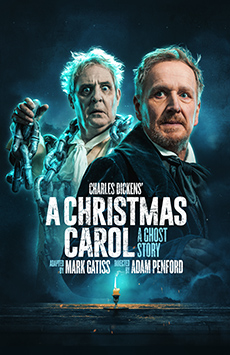
What happens in A Christmas Carol?
Mark Gatiss's adaptation stays closely faithful to Charles Dickens's 1843 novella while leaning hard into its identity as a Victorian winter ghost story.
The Christmas Eve haunting
Ebenezer Scrooge — miserly, miserable, contemptuous of Christmas and of everyone who keeps it — closes up his counting house on Christmas Eve, refuses an invitation to spend the day with his nephew Fred, grudgingly grants his overworked clerk Bob Cratchit the day off, and returns to his cold lodgings to sleep. There he receives an unexpected visitor: the apparition of his long-dead former business partner Jacob Marley, dragging the heavy chain of human suffering Marley forged in life and now wears, weighed down, in death.
The three spirits
Marley warns Scrooge that he faces an even heavier chain unless he changes. Three spirits will visit, Marley says. The Ghost of Christmas Past takes Scrooge back through the milestones of his own life — his lonely boyhood at boarding school, his sister Fan, his apprenticeship with the warm-hearted Fezziwig, and most painfully his broken engagement to Belle, whom he loved before money came first. The Ghost of Christmas Present shows him the world's Christmas Day as it is unfolding — the Cratchit household scraping together a meal around a small bird, Tiny Tim's failing health, Fred's party in which Scrooge's name is toasted with affection despite everything. And the silent Ghost of Christmas Future shows him the grave: an unmourned death, his own things being divided by strangers, Tiny Tim already dead in a parallel timeline.
The reckoning
Scrooge wakes on Christmas morning to find he has not missed the day. The rest of the play follows what redemption looks like in practice: an unexpected goose for the Cratchits, a raise for Bob, a visit to Fred's house, an apology where one is owed, money where it matters. Dickens called it "an honest endeavour to raise the Ghost of an Idea, which shall not put my readers out of humour with themselves, with each other, with the season, or with me." Gatiss's adaptation honours both the ghosts and the idea.
How Mark Gatiss's Carol became the Pally's Christmas fixture
The Nottingham Playhouse origin, 2021
A Christmas Carol: A Ghost Story premiered at Nottingham Playhouse in November 2021 — Adam Penford's first Christmas commission as the venue's artistic director. Gatiss adapted the novella from a position of long-standing fascination: his career-spanning interest in Victorian horror (The League of Gentlemen, The Tractate Middoth, Sherlock's Dickens references) made him a natural fit for an adaptation that prioritised the original story's supernatural undercurrent over its conventional festive packaging. Nicholas Farrell played the original Scrooge, with Gatiss himself appearing as Jacob Marley.
The first Alexandra Palace transfer, 2021–22
The production transferred to London almost immediately — to the Alexandra Palace Theatre's first major Christmas commercial booking since the venue's restoration. The half-restored Victorian splendour of the Ally Pally Theatre, which the Charitable Trust kept deliberately in its preserved-but-not-rebuilt state, was a near-perfect setting for a Victorian ghost story; the production sold out, the Telegraph awarded five stars, and a return became inevitable.
The 2023 return
The production returned to Alexandra Palace for Christmas 2023 with Keith Allen as Marley and Matthew Cottle as Scrooge — both fresh to the production. Peter Forbes played Marley in a parallel run that year. The 2023 run further cemented the production's London identity, and led to a filmed version subsequently shown in UK cinemas and broadcast on BBC4.
The 2024 Birmingham detour
In Christmas 2024 the production transferred to Birmingham Rep rather than London, bringing Kalifa Taylor, Mark Theodore and Lance West into the company — all three of whom returned for the 2025 Ally Pally run.
The 2025 third London season
For Christmas 2025, the production returned to Alexandra Palace for the third time. Matthew Cottle reprised his 2023 Scrooge; Neil Morrissey took over as Jacob Marley. The press night was 26 November; the run closed on 4 January 2026 as planned. The original creative team — Gatiss adapting, Penford directing, Wills designing, Gladwell lighting, Wahlström on sound, Dunn on video, Lamb on movement, Tingying Dong composing — remained intact across all three London seasons.
What's next
No Christmas 2026 season has been announced as of May 2026. The pattern of alternate-year returns to Alexandra Palace (2021, 2023, 2025) and the success of the 2024 Birmingham detour suggests either a regional run elsewhere or a further Ally Pally return at Christmas 2026 or 2027 is likely. Eleanor Lloyd Productions, Eilene Davidson Productions and Nottingham Playhouse will all be sources for any future announcement.