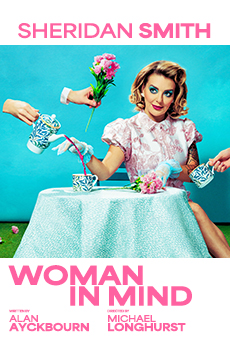
What happens in Woman in Mind?
The play opens with Susan — middle-aged, married to a vicar, two children grown — lying flat on the ground in her garden. She has hit her head on a garden rake. A doctor leans over her speaking what sounds, to Susan, like gibberish ("Squeezy cow, squeezy" — actually "Easy now, easy"). The audience hears the world from Susan's concussed perspective.
The two families
As Susan recovers, two families assemble around her, and the play's central conceit becomes clear. Her real family — Gerald, a tedious and emotionally absent vicar husband; Rick, an estranged adult son who has joined a religious sect; Muriel, a sister-in-law who has moved in and cooks unspeakable food — are dispiriting in completely realistic ways. Alongside them, Susan also has another family: Andy, a charming, attentive husband; Lucy, a doting adult daughter; Tony, an attractive younger brother. They are entirely imagined.
The blur
For the first act, Susan can tell the difference. The imagined family appears on cue, says lovely things, and disappears when the real family enters. Susan retreats into the fantasy when reality becomes intolerable; she steps back out when she needs to attend to a real conversation. Dr Bill (Romesh Ranganathan) — the GP attending to her concussion — is the only character who exists in both worlds, never quite registering that there are two of them.
The collapse
The second act tracks the system breaking down. Susan's two worlds begin to overlap. The imagined family arrives unbidden; they grow hostile rather than supportive; they begin to know things they should not know. The real family escalates in parallel: a disastrous garden party, an argument with Rick about his sect, a confession from Gerald about a book he is writing about the parish that reduces Susan to a footnote in her own marriage. The audience, which started the play sharing Susan's clarity, ends it sharing her confusion.
The ending
Ayckbourn famously resisted naming Susan's condition; the play is not a diagnosis. The ending — without spoilers — confirms that Susan has reached a place from which she cannot easily return, and the gibberish of the opening returns at the close with a different and more devastating meaning. Multiple reviewers across the 1986 and the 2025 runs described the final five minutes as among the most unnerving in Ayckbourn's catalogue.
Forty years of Woman in Mind
The 1985 Scarborough premiere
Woman in Mind received its world premiere at the Stephen Joseph Theatre in the Round in Scarborough on 30 May 1985, directed by Ayckbourn himself. It was his 32nd produced play (he has since written a further 59). Ayckbourn — by then established as one of the most-produced English playwrights of the second half of the twentieth century — was conscious that this play represented a sharp tonal departure from his earlier domestic comedies. So sharp, in fact, that his agent worried audiences would not accept an unreliable-narrator central character. A pre-publication brochure note famously joked: "At the time of going to press a high wall of secrecy surrounds this project. Some have the theory that this is to protect such highly original comic material from the risk of plagiarism. Others, more cynical, suggest that it could be due to the fact that the author hasn't started on it yet."
The 1986 West End run
The play transferred to the West End in 1986, opening at the Vaudeville Theatre on 3 September with Julia McKenzie as Susan. It ran until 4 July 1987. The play's transfer required adaptation from in-the-round Scarborough staging to a proscenium West End house — a change Ayckbourn later said he found more difficult than expected, since the proscenium "makes a scenic statement whether or not it is needed". Even in adapted form, the production drew strong reviews; Michael Billington's controversial description of Ayckbourn as "our leading feminist dramatist" came from a Guardian review of this run.
The international productions
The American premiere followed at the Manhattan Theatre Club on 17 February 1988, directed by Lynne Meadow with Stockard Channing as Susan. Helen Mirren played the role at the Tiffany Theatre in Los Angeles in 1992. The play has had a steady international life since: it remains one of the most-produced Ayckbourn plays globally outside his core farce catalogue (How the Other Half Loves, Bedroom Farce, The Norman Conquests).
The 2008 Janie Dee revival
Ayckbourn had intended to revive Woman in Mind with Janie Dee in the lead since 2006, but a stroke that February delayed the project. The revival eventually opened in autumn 2008 at the Stephen Joseph Theatre as part of Ayckbourn's final season as the venue's artistic director. After a successful month-long Scarborough run, the production transferred to the Vaudeville Theatre — the first Ayckbourn-directed West End production since Damsels in Distress, after a long-running dispute between Ayckbourn and West End commercial producers. Dee's performance was widely acclaimed; the production was produced by Bill Kenwright.
The 2025 Longhurst revival
The 40th-anniversary revival was first announced in summer 2025. Michael Longhurst — fresh from his five-year tenure as Donmar Warehouse Artistic Director — was attached to direct. Sheridan Smith was cast as Susan, returning to the Duke of York's Theatre after her 2023 Olivier-nominated run in Shirley Valentine. Romesh Ranganathan was the surprise addition: a major BAFTA-winning television comedian making his West End stage debut. The production was produced by Wessex Grove and Gavin Kalin Productions.
The run and the tour
Previews began at the Duke of York's Theatre in early December 2025, with the press night on 9 December. The run was planned at twelve weeks and closed on 28 February 2026. From there the production transferred to a short three-venue UK tour: Newcastle Theatre Royal in the week commencing 2 March 2026, Sunderland Empire (4–7 March 2026), and Theatre Royal Glasgow (10–14 March 2026). The tour closed the production for good on 14 March 2026. The published reviews — across both the London run and the regional dates — were among the strongest of any straight play in the 2025/26 West End season.