
Expert Review: Essential Theatre That Refuses Comfortable Conclusions
The Verdict
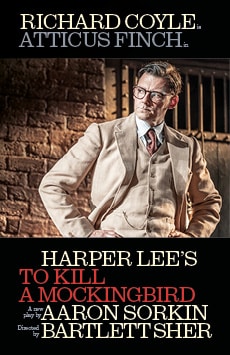
Aaron Sorkin's adaptation of Harper Lee's novel arrives at Wyndham's Theatre with its moral urgency fully intact and significantly amplified. Rather than simply dramatising the novel, Sorkin interrogates it — giving voice to characters Lee left in the margins and challenging Atticus Finch's quiet liberalism in ways that feel startlingly contemporary. Richard Coyle's Atticus is a man of genuine principle whose faith in the system is tested to breaking point, and the production's refusal to offer easy comfort makes it among the most important pieces of theatre currently playing in the West End.
What Makes It Special
- Sorkin's Interrogation of the Novel: Rather than the reverent adaptation many expected, Sorkin challenges Atticus's gradualism through the voices of Calpurnia, Tom Robinson, and others — forcing the play to ask whether well-meaning white liberalism is part of the problem it believes itself to be solving.
- Richard Coyle as Atticus: A performance of quiet authority and growing anguish, Coyle captures both the genuine decency and the limits of Atticus's worldview with equal precision. It is a complex, thoroughly human portrayal of a man discovering the inadequacy of his beliefs.
- Wyndham's Theatre: One of the West End's most beautiful venues, its Edwardian interior providing a formal elegance that throws the play's themes into sharp relief — justice dressed in marble failing those it claims to serve.
- Contemporary Relevance: Sorkin's Mockingbird speaks directly to ongoing debates about racial justice, institutional racism, and the limits of liberal good intentions. Its questions have not been answered since 1960, and the production makes no pretence that they have.
Perfect For
Anyone who loves Harper Lee's novel and wants to encounter it afresh; audiences interested in American history and its present echoes; fans of Aaron Sorkin's writing encountering it in its most serious mode; and anyone who believes theatre should challenge as well as move. To Kill a Mockingbird is not comfortable theatre — it is necessary theatre.
Everything You Need to Know
About To Kill a Mockingbird
Maycomb, Alabama, 1934. Lawyer Atticus Finch agrees to defend Tom Robinson, a Black man falsely accused of raping a white woman. Narrated by Atticus's young daughter Scout, Harper Lee's story of racial injustice and moral courage in the Depression-era American South has sold over 45 million copies since publication in 1960 and won the Pulitzer Prize for Fiction. Sorkin's adaptation transfers the story to the stage with the confidence to expand, challenge, and deepen what the novel begins.
Sorkin's Intervention
The most significant element of Sorkin's adaptation is its willingness to challenge Atticus's heroism. In Lee's novel, Atticus is a near-perfect moral exemplar whose patient faith in the justice system is presented as admirable even in failure. Sorkin's Atticus begins as this figure but is progressively challenged by Calpurnia, the family's Black housekeeper, whose perspective on white liberalism is far less admiring — and far more accurate about the system's true nature.
The Trial
Tom Robinson's trial remains the production's dramatic centrepiece. Sorkin's courtroom is both a forensic legal drama and a theatre of social performance, in which the mechanisms of white supremacy operate through procedure, decorum, and the language of fairness while producing a predetermined outcome. The gap between how the system presents itself and what it actually does is rendered with Sorkin's trademark precision.
Scout's Perspective
The production maintains Lee's use of Scout as narrator while complicating the adult hindsight through which she speaks. Scout's childhood perspective — her genuine incomprehension of racism's logic — provides the emotional access point for audiences while Sorkin's structural changes ensure the play never mistakes that incomprehension for wisdom.
Performance Schedule
- Dates: TBC 2026 — check LOVEtheatre for announcements
- Evenings: Monday–Saturday, 7:30pm
- Matinees: Wednesday & Saturday, 2:30pm
- Running Time: Approximately 2 hours 40 minutes including interval
Getting There
- Tube: Leicester Square (Northern & Piccadilly lines) — 3 minute walk
- Alternative: Charing Cross (5 min walk), Covent Garden (8 min walk)
- Bus: Routes 24, 29, 176 along Charing Cross Road
- Parking: Q-Park Theatreland on Whitcomb Street
Age Guidance & Content Warnings
Recommended for ages 12+. To Kill a Mockingbird deals with racial violence, racial injustice, sexual assault accusation, and the failures of the legal system. These themes are handled with intelligence and seriousness, but parents should consider their child's readiness for difficult historical content. The production is an excellent educational experience for teenagers studying the novel or American history.
Wyndham's Theatre
Built in 1899 and Grade II listed, Wyndham's Theatre is one of the West End's most beautiful intimate venues, seating 759 across stalls, dress circle, and upper circle. Its intimate scale makes it ideal for character-driven drama — no seat feels far from the action. Recent productions include The Motive and the Cue and various acclaimed transfers.
Booking Information
Tickets from approximately £36. Dates for the 2026 run are yet to be confirmed; check LOVEtheatre regularly for booking updates. Productions at Wyndham's Theatre typically sell out quickly, especially for award-winning transfers with major casts.
⭐⭐⭐⭐⭐ Full Expert Review
To Kill a Mockingbird arrives at Wyndham's Theatre as one of the most anticipated productions of the West End season, and Aaron Sorkin's adaptation fully justifies the expectation. This is not a reverent museum piece but a living, argumentative drama that takes Harper Lee's beloved novel seriously enough to interrogate it — to ask whether its hero is as heroic as advertised, and whether a system that destroys Tom Robinson while performing the language of justice can be redeemed from within.
Richard Coyle's Atticus: The production's casting of Richard Coyle is an inspired choice. Where some productions have leaned into Atticus's near-mythological status, Coyle plays him as a fallible, committed man — genuinely principled but limited by his faith in the institutions that fail him. His progressive disillusionment over the course of the trial is one of the production's great achievements, the erosion of certainty made physically visible.
Calpurnia's Challenge: The production's most striking element is the expanded role of Calpurnia, whose challenges to Atticus's approach force the play to confront what liberal gradualism costs the people it claims to serve. These scenes, largely invented by Sorkin, are the production's most politically charged — and its most necessary. They refuse the audience the comfort of straightforward admiration.
The Courtroom: Sorkin is at his most brilliant in the courtroom sequences, where the mechanisms of legal procedure and social performance intersect. The prosecution's strategy — winning not through evidence but through the jury's assumptions — is rendered with a clarity that makes its contemporary relevance unmistakable without ever becoming anachronistic.
Design: The production's design places the audience in a formal, imposing space that mirrors the institutional architecture of injustice — a world that looks like fairness and operates as anything but. The contrast between the warm domesticity of the Finch home and the cold ceremony of the courtroom is managed with great skill.
Final Verdict: Unmissable. To Kill a Mockingbird at Wyndham's Theatre is the kind of production that reminds you why theatre exists — to make the unbearable visible, to insist on moral reckoning, and to leave audiences changed rather than merely entertained.
Rating: 4.9/5 Stars