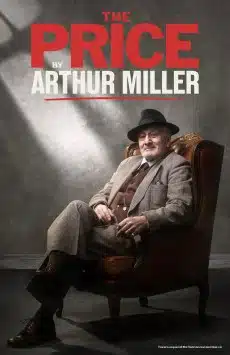
What Happens in The Price?
The action takes place entirely in the attic of a New York City brownstone scheduled for demolition. The furniture of a lifetime is piled high — the accumulated debris of a family's history, waiting to be appraised and sold. Victor Franz, a New York police officer, has arrived to oversee the disposal. He brings with him Gregory Solomon, an eighty-nine-year-old furniture dealer who hasn't worked in years, and his wife Esther, who nurses long-held resentments of her own.
The Brothers Reunite
Then Walter arrives — Victor's older brother, a successful surgeon, who cut himself off from the family years ago. The brothers haven't spoken in sixteen years. What was supposed to be a practical transaction becomes something else entirely: a reckoning with the choices each man made in the aftermath of their father's financial ruin during the Depression, and the price each has paid for those choices ever since.
Competing Versions of the Past
Victor believes he sacrificed his education and his dreams to support their father when Walter abandoned the family. Walter believes Victor chose dependency over freedom — that the sacrifice was chosen, not forced. Both men are convinced their version is true. Miller's genius is that he never definitively adjudicates between them. The audience is left to make its own judgement about what the past really held.
Solomon as Witness
Throughout the brothers' confrontation, Solomon functions as something more than a comic presence. His aged perspective — he has survived enough of his own losses to have developed a philosophical flexibility about them — provides an unexpected counterpoint to the brothers' rigid investment in their own narratives. His scenes with Victor are among the most touching in the play.
The Question of the Price
Miller's title operates on multiple levels. There is the literal price of the furniture. The price each brother has paid for his choices. And the deeper question of whether the cost of self-knowledge — truly understanding what we have done and why — is a price anyone is willing to pay.
About Arthur Miller and The Price
Miller's Personal Context
The Price premiered on Broadway in 1968, during one of the most turbulent years in American history. Miller wrote it partly in response to the fractures he saw in American society — the abandonment of collective responsibility in favour of individual advancement — and partly from deeply personal material. The play draws on the relationship between Miller and his own brother Kermit, whose life choices mirrored Victor's, and who Miller believed had been sacrificed to family obligation.
Why It's Been Underrated
The Price has always suffered from comparison with Miller's most celebrated works. Death of a Salesman and The Crucible have the scale and allegorical weight that make them easy to teach and programme. The Price is quieter, more chamber-like, less obviously symbolic. But for audiences prepared to give it their full attention, it offers rewards those larger works cannot: an intimacy, a psychological precision, and a refusal to resolve its central dilemmas that feels extraordinarily modern.
The American Dream Revisited
Like all Miller's best work, The Price uses its specific American story to ask universal questions. The choice between individual ambition and family obligation — between Walter's freedom and Victor's loyalty — maps onto questions that every generation faces. Miller's insistence that both brothers are simultaneously right and self-deceived gives the play a moral complexity that makes it endlessly discussable.
A History of Great Revivals
The Price has attracted major actors throughout its history. A 2017 Broadway revival starring Mark Ruffalo, Tony Shalhoub, and Danny DeVito introduced the play to a new generation. This Marylebone Theatre production continues that tradition of finding the play's contemporary relevance in the context of intimate, focused staging.
Performance Schedule
- Previews begin: 17 April 2026
- Final Performance: 7 June 2026
- Evenings: Monday–Saturday, 7:30pm
- Matinees: Wednesday & Saturday, 2:30pm
- Running Time: Approximately 2 hours 30 minutes including interval
Age Guidance & Content Warnings
Recommended for ages 14+
The play deals with themes of family breakdown, economic hardship, grief, and long-held resentment. There is no explicit content or strong language, but the emotional intensity of the central confrontations may be distressing for some audiences. The play is entirely suitable for engaged older teenagers and adults.
Getting There
- Tube: Baker Street (Bakerloo, Circle, H&C, Jubilee, Metropolitan lines) – 5 minute walk
- Buses: Routes 18, 27, 30, 205 serve nearby stops
- Parking: Limited street parking; Marriott Marble Arch car park on George Street is a reasonable option
Marylebone Theatre
One of London's most appealing off-West End venues, Marylebone Theatre is located at 35 Park Road, London NW1 6XT. Its intimate auditorium seats around 200 across a single level, offering exceptional sightlines and an unusually close relationship between performers and audience. The theatre's scale makes it ideally suited to character-driven drama of the kind Miller wrote.
Accessibility
Marylebone Theatre offers step-free access and hearing loop facilities. Contact the box office in advance to arrange specific accessibility requirements. Dedicated accessible seating is available throughout the auditorium.
Ticket Prices
Tickets range from approximately £20 for restricted-view seats to £65 for premium positions. A small number of day seats are released each morning at reduced prices — worth checking if you are flexible on timing.