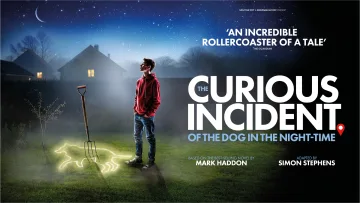
What Happens in The Curious Incident?
Christopher John Francis Boone is fifteen years old. He knows all the countries of the world and their capitals, and all the prime numbers up to 7,507. He finds human interaction difficult to navigate and much of social behaviour baffling. He has never been further than the end of his road alone. Then, one night, he discovers the body of his neighbour's dog, Wellington, killed with a garden fork.
The Investigation Begins
Christopher decides to find out who killed Wellington and to write a murder mystery novel about the investigation. His teacher Mrs Siobhan encourages the project. As Christopher gathers evidence — interviewing neighbours, noting details, constructing timelines — he uncovers something entirely unexpected: a secret his parents have been keeping from him, one that changes everything he thought he knew about his own life.
The Journey
What follows is simultaneously a detective story, a journey narrative, and a portrait of a family under unbearable pressure. Christopher, armed with his extraordinary literal mind and his fierce determination, has to navigate the chaos of London and then the crowded, overwhelming complexity of the city itself. For Christopher, the simplest journey involves navigating a world of sensory overload and social unpredictability that most people take for granted.
The Parents
Ed and Judy Boone are not villains. They are people who have been overwhelmed by the demands of raising a child they love and cannot always understand, and who have made bad choices under pressure. The play refuses to condemn or redeem them simplistically, and this moral complexity is part of what makes it so affecting.
Christopher's Voice
The story is narrated by Christopher himself, through the murder mystery novel he is writing — which means the audience experiences events entirely through his perspective, with all the precision, honesty, and occasional blind spots that entails. This narrative strategy, brilliantly realised in Simon Stephens's adaptation, is the source of much of the production's emotional and comic power.
About the Production
From Novel to Stage
Mark Haddon's novel, published in 2003, was an immediate sensation — praised for its innovative use of a neurodivergent narrator to tell a story that was simultaneously funny, moving, and formally original. It spent over two years on the bestseller lists. Simon Stephens's stage adaptation, which premiered at the National Theatre in 2012 in a production directed by Marianne Elliott, achieved the seemingly impossible: it improved on the source material, finding theatrical solutions to problems that seemed insoluble on the page.
The Awards
The production won seven Olivier Awards in 2013, including Best New Play, Best Director, and Best Actor, and five Tony Awards when it transferred to Broadway in 2015. It has been touring nationally and internationally since its original run, introducing the story to new audiences across the world. Each touring cast is carefully selected to maintain the high standards of the original production.
The Design
Marianne Elliott's production is inseparable from Bunny Christie's design — a box set of luminous white lines against black, transforming to represent Christopher's mathematical, patterned perception of the world. The set is not merely a backdrop but an active element of the storytelling, responding to Christopher's emotional state and shifting to represent different locations and states of mind. Combined with Paule Constable's lighting and Ian Dickinson's sound, it creates an immersive theatrical environment that has no equivalent in contemporary staging.
The Touring Company
The touring production maintains the creative and technical standards of the original, with a company trained in the physical vocabulary developed for the show and with the full design package. The production adapts to different venue sizes and shapes while preserving the intimate intensity that makes it so affecting.
Performance Schedule
- Run dates: 10–14 November 2026
- Evenings: Monday–Saturday, 7:30pm
- Matinees: Wednesday & Saturday, 2:30pm
- Running Time: Approximately 2 hours 20 minutes including interval
Very Limited Run — Book Now
This is a touring engagement of only five days — ten performances in total across one week. Given the production's reputation and the limited availability, selling out is likely. Early booking is essential.
Age Guidance & Content Warnings
Recommended for ages 11+
The production uses strobe lighting effects and intense sound design. Audience members with photosensitive conditions should review the theatre's advisory notices before attending. The story deals with family breakdown and parental deception. Relaxed performances with reduced effects are available on selected dates — contact the box office for details.
Getting There
- Tube: Wimbledon (District line) – 2 minute walk
- Rail: Wimbledon (South Western Railway) – same interchange
- Tram: Wimbledon tram stop – same interchange
- Buses: Routes 57, 93, 200, 219 and others serve The Broadway
- Parking: Pay-and-display available on The Quadrant nearby
New Wimbledon Theatre
New Wimbledon Theatre is one of south London's finest performance venues, located at The Broadway, Wimbledon, SW19 1QG — directly adjacent to Wimbledon transport interchange. A beautifully preserved Victorian theatre built in 1910, it hosts major touring productions from the West End and beyond throughout the year. Its comfortable auditorium seats approximately 1,670 across stalls, dress circle, and upper circle.
Accessibility
New Wimbledon Theatre is fully accessible with step-free access to the stalls and an induction loop throughout the auditorium. Audio-described and captioned performances are available on selected dates. Contact ATG Tickets for detailed accessibility information and to arrange specific requirements.
Ticket Prices
Tickets typically range from approximately £20 for restricted-view seats to £65 for premium stalls positions. With only five days of performances, availability will be limited — book as early as possible.