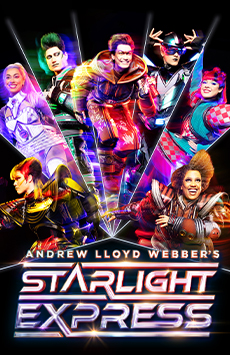
What happens in Starlight Express?
Starlight Express takes place in the imagination of a child playing with a toy train set. The trains come to life, and each engine and carriage becomes a character with its own personality, costume and style of skating.
The championship
The engines compete in a championship to find the fastest train in the world. The favourites are the flashy, arrogant diesel Greaseball and the electric newcomer Electra, both far newer and faster than Rusty, a humble steam engine who is told he is out of date.
Rusty and the Starlight Express
Rusty's mother, Momma McCoy, tells him about the Starlight Express, a legendary train that helps those who believe in themselves. With that encouragement, and with the observation car Pearl beside him, Rusty takes on the faster engines in a series of races.
The final
The story builds to a final race in which old-fashioned steam goes up against diesel and electric. It is a simple story about self-belief, told at speed, and built around the spectacle of a cast racing on roller skates.
From the Apollo Victoria to Wembley
The 1984 original
Starlight Express opened at the Apollo Victoria Theatre in London on 27 March 1984, directed by Trevor Nunn with choreography by Arlene Phillips, and ran for eighteen years. A Broadway production followed in 1987, and a German production in Bochum, in a theatre built for the show, opened in 1988.
The 2024 revival
For the fortieth anniversary, director Luke Sheppard reworked the show at Troubadour Wembley Park Theatre, which was reconfigured as the Starlight Auditorium. The creative team included choreographer Ashley Nottingham, set designer Tim Hatley, costume designer Gabriella Slade, lighting designer Howard Hudson and sound designer Gareth Owen, with Arlene Phillips returning as creative dramaturg. Previews began on 8 June 2024.
Awards and success
The production won seven awards at the 2025 WhatsOnStage Awards, including Best Musical Revival, and received three Olivier nominations. The cast recording, released in November 2024, passed 17 million streams. The run was extended seven times before closing on 3 May 2026.
The world tour
The production begins its first world tour at Curve Leicester in May 2027. UK dates announced so far include Liverpool, Glasgow, Sunderland, Birmingham and Southampton, running to September 2027, with further cities to be announced. None of the announced dates are in London.
Troubadour Wembley Park Theatre
Troubadour Wembley Park Theatre is a large modern venue in the Wembley Park development in north-west London, close to Wembley Stadium and Wembley Park Underground station.