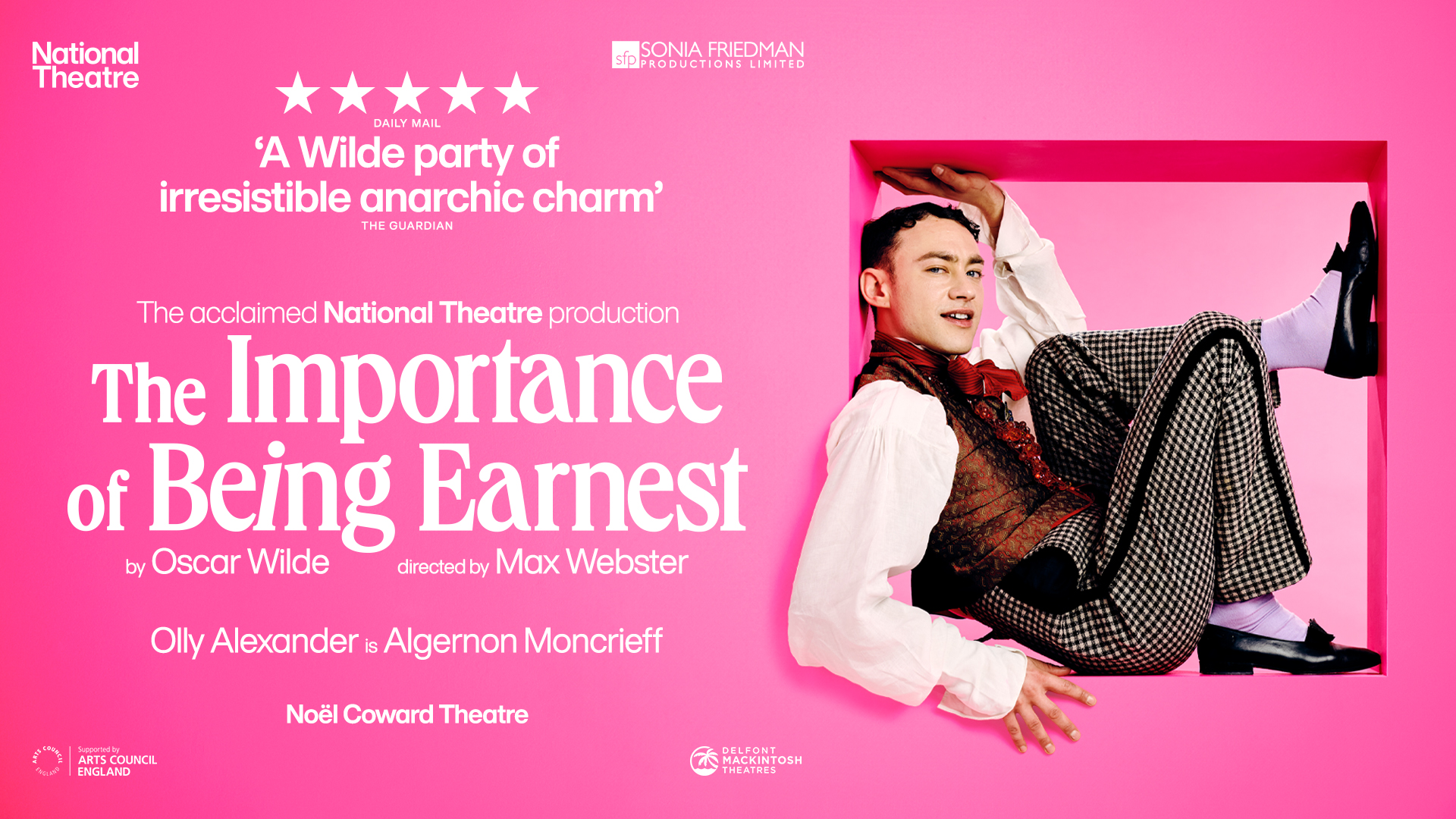
What happens in The Importance of Being Earnest
Wilde's play is a three-act comedy about two London gentlemen who have both, independently, invented fictional alter egos in order to escape the constraints of respectable Victorian life. The plot turns on the consequences of that double-life, the romantic entanglements that follow, and a long-delayed revelation about identity in the third act.
Act I — Algernon's flat, Mayfair
Algernon Moncrieff, a wealthy and idle young man, is visited at his Mayfair flat by his friend Jack Worthing, who has come to town to propose to Algy's cousin Gwendolen Fairfax. Algy discovers that Jack — who calls himself Ernest in London and Jack in the country, where he has a young ward called Cecily Cardew — has been leading a double life. Algy reveals that he too has invented a fictional invalid friend, Bunbury, to escape unwanted social obligations. Gwendolen arrives with her mother, the formidable Lady Bracknell, and accepts Jack's proposal. Lady Bracknell, however, refuses to allow her daughter to marry a man whose origins are obscure — he was famously found as a baby in a handbag at Victoria Station.
Act II — Jack's country house, Hertfordshire
Algernon arrives at Jack's country house in Hertfordshire, having invented an excuse to meet Cecily — Jack's young ward, whom Algy has heard about and become fascinated by. Algy introduces himself to Cecily as Jack's "wicked brother Ernest." Cecily, who has long been infatuated with the idea of a wicked brother called Ernest, falls in love with him. Gwendolen also arrives unexpectedly. When the two young women compare notes and discover they are each engaged to "Ernest," the plot reaches its first comic crisis.
Act III — Resolution
Lady Bracknell arrives to retrieve her daughter and discovers, in the final act, that Miss Prism (Cecily's governess) was once a nursemaid in the Bracknell household — and that the baby she absent-mindedly left in a handbag at Victoria Station some thirty years earlier is, in fact, Jack. He is therefore Algernon's elder brother and Lady Bracknell's nephew. The handbag-baby revelation produces the play's famous closing twist: Jack discovers that his original Christian name was indeed Ernest, vindicating his and Gwendolen's marriage. Algernon and Cecily are also free to marry. The play ends with Jack's curtain line: "I've now realised for the first time in my life the vital Importance of Being Earnest."
Webster's reading
Max Webster's production foregrounded what is already present in the play — that Earnest is fundamentally about double lives, performed identity, secret desires hidden behind social convention, and the gap between the version of oneself one shows in public and the version one lives in private. The production treated this as the play's queer DNA and embraced it directly, with what critics described as drag-inflected style, anachronistic flourishes and a gleeful theatricality that never punctured Wilde's writing.
The historical context of Earnest
Wilde and 1895
The Importance of Being Earnest premiered at the St James's Theatre, London on 14 February 1895, in a production directed by George Alexander. Wilde had two plays running in the West End simultaneously — An Ideal Husband and the new piece — and was at the height of his commercial success. Within three months of the premiere, Wilde would be arrested, tried and convicted under the Criminal Law Amendment Act for "gross indecency" with men, sentenced to two years' hard labour, and effectively destroyed as a public figure. His name was removed from the playbills of both productions within weeks; Earnest closed after only 86 performances.
A play about hidden lives
The fact that Wilde's most enduring comedy is a play about double lives, secret identities and the gap between public respectability and private desire is the central historical irony of his career — and one that almost every modern director engages with directly or indirectly. Wilde was writing in coded terms about a way of living that he himself was living, and which would shortly destroy him. Webster's 2024 production was unusually explicit in foregrounding this: rather than treating the play's queer subtext as a discreet undercurrent, the production celebrated it as the play's actual subject matter.
The "bunburying" subtext
One of the play's most famous coinages — "bunburying," meaning the invention of a fictional friend or relative as a pretext to escape social obligations — has long been understood as code for the kind of escape that gay men of Wilde's class had to engineer in order to live double lives. Algernon's Bunbury, Jack's "Ernest," and the entire structure of the play's deceptions take on a different weight when read in light of Wilde's own life. Webster's production didn't make this explicit in the text, but the staging and performance choices made the reading inescapable.
The play's afterlife
After Wilde's release from prison in 1897 and his death in Paris in 1900, Earnest became one of the most-performed plays in the English-speaking world and a fixture of the modern repertoire. Major film adaptations include Anthony Asquith's 1952 version (with Edith Evans's canonical Lady Bracknell) and Oliver Parker's 2002 version. The play has been a vehicle for some of the great theatrical performances of the twentieth century, particularly in the role of Lady Bracknell — played by Dame Edith Evans, Dame Judi Dench, Geoffrey Rush, David Suchet and many others. Stephen Fry had been attached to a West End production as Lady Bracknell in 2014; that production didn't proceed, making the 2025 Noël Coward Theatre run the realisation of a long-held ambition.
The National Theatre and Sonia Friedman co-production
The 2024–26 production was a co-production between the National Theatre and Sonia Friedman Productions — a model the NT has used several times for productions that begin at the Lyttelton or Olivier and transfer to commercial West End runs. The arrangement allows the National to commission ambitious work without bearing the full commercial risk of a long West End run, while giving Friedman's commercial production company access to the National's creative resources. Recent successful examples of the partnership include Dear England and The Motive and the Cue.
NT Live and global reach
The National Theatre filmed the Lyttelton production for NT Live during its 2024–25 run. From February 2025, the filmed performance — starring Sharon D Clarke as Lady Bracknell and Ncuti Gatwa as Algernon — was screened in cinemas internationally, reaching over 175,000 cinemagoers. The filmed version was subsequently made available to subscribers via National Theatre at Home, and the NT released the production for free on YouTube for a limited window in March 2026 as part of the "Take Your Seats" initiative, with a live digital watch-along premiere. It became one of the most widely-distributed NT Live releases of the period.