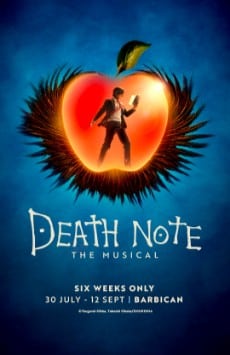
What happens in Death Note: The Musical?
Death Note: The Musical follows Light Yagami, a top-scoring high school student in Tokyo who is brilliant, bored, and increasingly convinced that the world is rotten and beyond reform. He finds the Death Note — a notebook discarded by Ryuk, a shinigami (god of death) — and discovers its power: write a person's name in its pages while picturing their face, and that person will die.
Kira is born
Light begins using the notebook to kill criminals, convincing himself he is performing a necessary service — clearing the world of those who deserve to die. His actions attract worldwide attention; the media and public begin calling the mysterious killer Kira (from the Japanese pronunciation of "killer"). Light's mission grows from individual executions to a broader vision: a new world order, purged of evil, with Light himself as its god.
The arrival of L
Interpol brings in L — an eccentric, reclusive detective of extraordinary intelligence who has never failed to solve a case — to investigate the Kira killings. L quickly deduces that Kira is in Japan and narrows his focus. What follows is a sustained cat-and-mouse game between two extraordinary minds, each trying to identify and destroy the other without revealing themselves. The musical's central tension — which of these two characters is the hero, and which the villain — is one of the great pleasures of the source material, and the score exploits it relentlessly.
The moral argument
Death Note is fundamentally a story about the corrupting nature of absolute power and the impossibility of playing god without becoming a monster. Light begins as a recognisable idealist; his transformation into something far darker is gradual, convincing, and genuinely disturbing. The musical's score charts that transformation in musical terms — Light's solos shifting from conviction to grandiosity to something approaching madness as the stakes rise and the losses accumulate.
From manga to musical
The manga
Death Note was written by Tsugumi Ohba and illustrated by Takeshi Obata, serialised in Weekly Shonen Jump from 2003 to 2006. It has sold over 30 million copies worldwide and is consistently ranked among the most influential manga of its era. Its psychological complexity — the story is as much a chess match as a thriller — distinguished it from most shonen manga of the period and gave it an unusually broad adult readership alongside its teenage fanbase.
The anime and adaptations
The Death Note anime aired from 2006 to 2007 and became one of the most watched anime series globally. It was followed by Japanese live-action films (2006, 2008), a television drama series (2015), and a Netflix original film (2017). The franchise has maintained extraordinary popularity across multiple adaptations and generations of fans, making it one of the most recognisable Japanese IP properties in the world.
The musical in Asia
Death Note: The Musical was first staged in Japan in 2015, produced by HoriPro — one of Japan's most prominent entertainment companies. It subsequently played multiple sell-out seasons in South Korea and Taiwan. The score by Frank Wildhorn, who was brought in to provide the musical's Western theatrical language, was praised across all three markets for its integration of dramatic weight with melodic accessibility.
The 2023 London concerts
English-language concert stagings took place at the London Palladium (August 2023) and the Lyric Theatre (September 2023), marking the first time the show had been performed in English. Both engagements sold out entirely, with a cast that included Adam Pascal (Rent), Dean John-Wilson, Frances Mayli McCann, and Aimie Atkinson. The response demonstrated clearly that London had the audience for a full production — which this Barbican world premiere now provides.
The creative team
Stephen Whitson has directed two of the UK's biggest recent musical imports: Hamilton and Moulin Rouge!. Jon Bausor's design work at the Barbican (Spirited Away) showed his command of the venue's scale. Choreography by Fabian Aloise, Olivier Award-nominated for his work on Evita at the London Palladium, completes a creative team with exceptional West End credentials. The orchestrations and arrangements are by Jason Howland, who worked on the original production.
Performance schedule
- Run: Thursday 30 July – Saturday 12 September 2026
- Total performances: 50 only
- Evenings: 7:30pm (finishing approximately 9:50pm)
- Matinees: 2:30pm (finishing approximately 4:50pm)
- Running time: Approximately 2 hours 20 minutes including one 15-minute interval
Confirm specific performance days when booking — not all days have performances. This is a strictly limited 50-performance run.
Age guidance and content
Recommended for ages 12 and above. Death Note: The Musical deals with themes of death, moral ambiguity, vigilante justice, psychological manipulation, and the corruption of idealism. It is not suitable for young children. Teenagers who are fans of the manga or anime are the ideal audience.
Tickets and pricing
Tickets range from £30 to £180. This is a limited 50-performance run with high demand expected — advance booking strongly recommended. Premium seats and weekend performances are likely to sell quickly.
Creative team
- Music: Frank Wildhorn
- Lyrics: Jack Murphy (additional lyrics: Morgan Reilly)
- Book: Ivan Menchell
- Director: Stephen Whitson
- Designer: Jon Bausor
- Choreographer: Fabian Aloise
- Orchestrations & Arrangements: Jason Howland
- Producers: HoriPro and Trafalgar Theatre Productions (in association with the Barbican)
- Based on the manga by: Tsugumi Ohba (writer) and Takeshi Obata (illustrator)
Full cast to be announced. This page will be updated when casting is confirmed.
Getting there
- Barbican station: Circle, Metropolitan and Hammersmith & City lines — approximately 5-minute walk. Head to Level G inside the Barbican Centre and follow signs to the theatre.
- Moorgate station: Circle, Metropolitan, Hammersmith & City, and Northern lines — approximately 8-minute walk.
- Liverpool Street station: Multiple lines and National Rail — approximately 10-minute walk.
- By bus: Numerous routes serve the Barbican area.
- Parking: Car parking available at the Barbican Centre — book in advance.
About the Barbican Theatre
The Barbican Theatre is the main performance space within the Barbican Centre, one of Europe's largest arts complexes. The 1,156-seat theatre has been home to some of London's most ambitious theatrical productions over the past four decades. In recent years the Barbican has established itself as the go-to venue for large-scale theatrical productions with international origins — including My Neighbour Totoro and Spirited Away — and Death Note continues that programming vision.
Accessibility
The Barbican Theatre offers wheelchair spaces in the rear of the stalls and in row B of the upper circle, both with companion seats. Row B is reached via a platform lift, and staff are available to assist. Audio-described performances are available, with headsets available from the sales kiosk. Assistance dogs are welcome in the theatre. Contact the box office in advance to discuss specific access requirements and book accessible spaces.