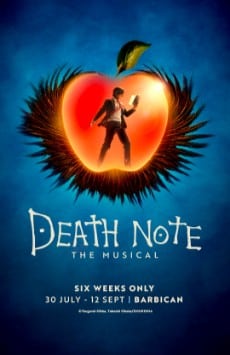
What Happens in Death Note: The Musical?
Light Yagami is a brilliant, frustrated student who believes the world is rotten and deserves to be cleansed. One day he discovers a notebook that has fallen from the sky — the Death Note, which belongs to the Shinigami (death god) Ryuk. Any human whose name is written in the notebook dies.
The Birth of Kira
Light begins using the Death Note to kill criminals, taking on the vigilante identity of Kira — a word that becomes synonymous with a new kind of justice, or a new kind of terror, depending on your point of view. As criminals begin dying in custody, the world is divided: those who see Kira as a god of justice, and those who see a murderer operating without accountability or due process.
Enter L
The world's greatest detective, known only as L, becomes obsessed with unmasking Kira. Eccentric, brilliant, and deeply committed to justice defined by law rather than outcome, L begins closing in on Light — setting up one of fiction's greatest cat-and-mouse duels. The two men eventually meet, each aware the other suspects him, and the intellectual battle becomes intensely personal.
The Moral Questions
At the heart of the story is a genuine philosophical argument. Is it wrong to kill a murderer? Does the outcome justify the method? What separates justice from revenge? Light's ideology is coherent and even persuasive — until you watch what it does to him. The musical explores this corruption with real dramatic intelligence, tracking Light's dehumanisation through song as much as through action.
Ryuk's Commentary
Throughout, Ryuk observes with detached amusement. He gave the notebook to Light out of boredom rather than malice — he simply wanted to see what a human would do with it. His commentary provides both dark comedy and a philosophical counterpoint: a reminder that from a sufficient distance, human moral struggles are simply entertaining.
The Death Note Phenomenon
The Original Manga
Death Note was created by writer Tsugumi Ohba and artist Takeshi Obata and serialised in Weekly Shonen Jump from 2003 to 2006. The 108-chapter story became one of the most successful manga series of its era, praised for its sophisticated plotting, moral complexity, and the extraordinary intellectual chemistry between its two leads. The subsequent anime adaptation, aired 2006–07, brought the story to a global audience and became one of the defining anime series of the modern era.
The Musical's Origin
The stage musical originated in Japan, with a score and book developed to capture the story's philosophical ambition in theatrical form. International tours have brought the show to audiences across Asia and Europe, building a devoted following and attracting considerable critical attention for its willingness to treat the source material's moral seriousness with respect.
Why the Barbican?
The Barbican Theatre, with its capacity of around 1,166 and its reputation for ambitious programming that bridges popular and arts audiences, is an ideal home for this production. The venue's technical capabilities support the show's demanding design requirements, and its audience — curious, open to new work, drawn from across the full range of London's cultural life — is perfectly matched to a show that demands active intellectual engagement.
Do You Need to Know the Source Material?
Not at all. The musical is entirely self-contained, introducing characters and the rules of the Death Note clearly and efficiently. Prior fans will have the pleasure of seeing a beloved story staged with care; newcomers will encounter a compelling, morally complex musical drama that stands fully on its own terms.
Performance Schedule
- Opening Night: 30 July 2026
- Final Performance: 12 September 2026
- Evenings: Monday–Saturday, 7:30pm
- Matinees: Wednesday & Saturday, 2:30pm
- Running Time: Approximately 2 hours 45 minutes including interval
Age Guidance & Content Warnings
Recommended for ages 13+
The show deals with themes of death, moral corruption, vigilante justice, and ideology. It does not contain graphic stage violence, but the subject matter is dark and the moral questions it raises are genuinely complex. Parental guidance is recommended for younger teenagers.
Getting There
- Tube: Barbican (Circle, H&C, Metropolitan lines) – 5 minute walk
- Alternative tube: Moorgate (Northern, Circle, H&C, Metropolitan lines) – also nearby
- Parking: Barbican Estate car park on-site; cycle storage available
Barbican Theatre
Part of the Barbican Centre arts complex at Silk Street, London EC2Y 8DS, the Barbican Theatre is one of London's largest and most technically sophisticated performance spaces. Seating approximately 1,166 across stalls and three levels of circle, it combines impressive scale with surprisingly good sightlines throughout. The surrounding Barbican complex includes restaurants and bars for pre- and post-show dining.
Accessibility
The Barbican Theatre is fully accessible with step-free routes from street level to all areas of the auditorium. Audio description, captioned, and relaxed performances are available on selected dates. Contact the Barbican box office for full accessibility information.
Ticket Prices
Tickets typically range from approximately £25 for restricted-view or upper circle seats to £85 for premium stalls positions. High demand is expected given the production's built-in fanbase — early booking is advised for the best availability and pricing.