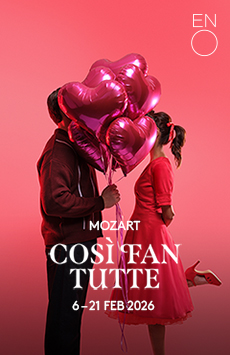
The Story of Così fan tutte
Set in 18th-century Naples, Così fan tutte tells the story of two young officers, Ferrando and Guglielmo, who are convinced their fiancées are completely faithful. The cynical philosopher Don Alfonso bets them that all women are unfaithful - "così fan tutte" (they all do it that way) - and devises a test to prove his point.
The Experiment
The men pretend to go to war but return in disguise as exotic foreigners, each attempting to seduce the other's fiancée. What begins as a simple test becomes increasingly complex as genuine emotions develop and the characters discover uncomfortable truths about themselves and their relationships.
The Characters
- Fiordiligi: Dorabella's sister, initially steadfast in her loyalty but gradually tempted
- Dorabella: More impulsive than her sister, quicker to succumb to temptation
- Ferrando: Young officer, initially confident in his beloved's fidelity
- Guglielmo: His friend and fellow officer, equally sure of his lover's faithfulness
- Don Alfonso: Cynical philosopher who orchestrates the test
- Despina: The sisters' maid, who aids the deception for her own amusement
The Resolution
The opera's ending is deliberately ambiguous, leaving audiences to ponder whether the characters have learned valuable lessons about love and human nature, or whether the damage to their relationships is irreparable.
Musical Highlights
- "La mia Dorabella" - Ferrando's confident opening aria about his beloved's faithfulness
- "Smanie implacabili" - Dorabella's dramatic lament when the men leave for war
- "Come scoglio" - Fiordiligi's magnificent aria of resistance, one of opera's most challenging soprano pieces
- "Un'aura amorosa" - Ferrando's beautiful aria about the power of love
- "Per pietà, ben mio" - Fiordiligi's heart-wrenching aria as she struggles with temptation
- "Donne mie, la fate a tanti" - Guglielmo's bitter aria about women's fickleness
- "Soave sia il vento" - The sublime trio as the men depart, one of Mozart's most beautiful pieces
Musical Style: Mozart combines opera buffa (comic opera) traditions with psychological depth, creating music that is simultaneously entertaining and emotionally complex. The ensemble writing is particularly sophisticated, with characters often singing conflicting emotions simultaneously.
Practical Information
Performance Schedule
- Opera seasons vary: Check ENO website for specific dates
- Evening performances: Usually 7:00pm or 7:30pm
- Matinee performances: Usually 2:00pm or 2:30pm
- Duration: Approximately 3h 15min with two intervals
Getting There
- Underground: Leicester Square (2 min walk) or Charing Cross
- Buses: Multiple routes to Trafalgar Square and St Martin's Lane
- Parking: Very limited - public transport strongly recommended
Theatre Information
- Historic opera house opened in 1904
- Capacity: 2,359 seats - London's largest theatre
- Full accessibility with lifts and hearing loops
- Dress code: Smart casual to formal (though more relaxed than some opera houses)
- Multiple bars available throughout the building
- Opera shop with recordings and merchandise
Language and Accessibility
- Sung in: Italian
- Surtitles: English translations displayed above stage
- Audio described performances: Available for visually impaired patrons
- Signed performances: Occasionally available
Age Guidance
Recommended for ages 12+ due to mature themes about infidelity, sexual desire, and relationship dynamics. While presented as comedy, the psychological complexity may be challenging for younger viewers.