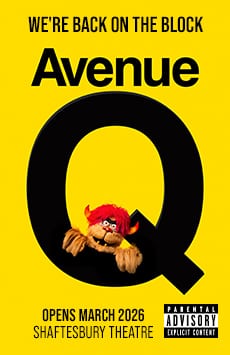
What happens in Avenue Q?
Princeton arrives in New York with a degree in English, no money, no plan, and no idea what his purpose is. The only apartment he can afford is on Avenue Q — a shabby outer borough far from the glamorous Manhattan he imagined. His neighbours are an unusual community of humans and puppets, all wrestling with the same adult problems: rent, career disappointment, romantic failure, and the nagging sense that life should be more than this.
The residents of Avenue Q
Princeton's immediate neighbours include Kate Monster, a teaching assistant with ambitions to open a school for monsters, who falls for him; Rod and Nicky, a mismatched pair of best friends — Rod is a closeted investment banker, Nicky is an easygoing slacker who can't understand why his roommate is so uptight; Brian and Christmas Eve, a human couple in which Brian is cheerfully unemployed and Christmas Eve is a hardworking Japanese therapist with no clients; Trekkie Monster, a reclusive creature who rarely emerges from his apartment; and Gary Coleman, the former child star, who works as the building's superintendent and is permanently aggrieved about it.
The show's emotional core
Beneath the comedy, Avenue Q is a musical about the transition from the optimism of youth to the compromises of adult life. The opening number — What Do You Do with a B.A. in English? — sets this up cleanly: Princeton expected his degree to mean something. His neighbours expected their various dreams to have worked out differently. The show follows these characters as they navigate love, purpose, disappointment, and the slow discovery that "for now" — the show's closing philosophical proposition — is actually enough.
The ending
The final number, For Now, argues that everything is only temporary — bad things and good things alike — and that finding contentment in the provisional is the adult skill the show has been building toward. It is a modest conclusion for what is otherwise a very loud and rude musical, and it lands with real feeling every time. The show's intelligence is that it earns the sentiment rather than assuming it.
Avenue Q: the story of the show
Origins
Robert Lopez and Jeff Marx began developing Avenue Q in the late 1990s while both were working in New York. The original concept was a satire on Sesame Street — using the aesthetics and grammar of children's educational television as the frame for an adult comedy about the anxieties of post-college life. Jeff Whitty joined as book writer, and the project developed through various workshops before making its off-Broadway debut at the Vineyard Theatre in New York in March 2003.
Broadway and the Tony Awards
Avenue Q opened on Broadway at the John Golden Theatre on 31 July 2003, directed by Jason Moore. The show won three Tony Awards in 2004: Best Musical, Best Original Score, and Best Book of a Musical — famously defeating Wicked, which had opened in the same season and been widely expected to sweep. The New York Times critic described the win as one of the great upsets in Tony history. The show ran on Broadway until 2009 and then continued off-Broadway at New World Stages until 2012.
The West End
Avenue Q opened in London at the Noel Coward Theatre on 28 June 2006 and transferred to the Gielgud Theatre before closing in 2010 after a four-year run. The London cast included Simon Lipkin as Princeton, Julie Atherton as Kate Monster, and Giles Terera — now starring in One Flew Over the Cuckoo's Nest at the Old Vic in 2026 — as Rod. The show has toured the UK multiple times in subsequent years.
Robert Lopez's subsequent career
Robert Lopez is one of the most celebrated composers in contemporary musical theatre. After Avenue Q, he co-created The Book of Mormon (2011) with Trey Parker and Matt Stone, which won nine Tony Awards including Best Musical. He then wrote the music for Disney's Frozen (2013), for which Let It Go won the Academy Award for Best Original Song. In 2017, he became one of only a handful of people to achieve the EGOT — winning Emmy, Grammy, Oscar, and Tony Awards. Lopez and Marx's Avenue Q score is the foundation of that career, and hearing it in a full West End production is something the 20th anniversary season makes newly possible.
The 2026 revival
The 2026 Shaftesbury Theatre production reunites Jason Moore as director, Rick Lyon as puppet designer and performer, and Anna Louizos as set designer — the three core creative figures from the original Broadway production. The show has received minor script updates (references to Trump, AI, and contemporary technology) while preserving its original structure. The Shaftesbury Theatre is operating at reduced capacity in 2026 due to renovation work, creating a more intimate experience than previous London runs.
Performance schedule
- Booking until: 29 August 2026
- Evenings: Monday to Saturday, 7:30pm
- Matinees: Thursday and Saturday, 2:30pm
- Running time: Approximately 2 hours 15 minutes, including one interval
The schedule may vary — confirm your specific date when booking.
Age guidance and content
Recommended for ages 13 and above. Children under 16 must be accompanied by and seated next to a ticketholder aged 18 or over. Babies and toddlers under 3 are not admitted. Everyone, regardless of age, must have their own ticket.
Avenue Q contains strong language, adult themes, sexual content (including puppet sex scenes), and comedic treatment of race and sexuality. It is an adult show with a children's television aesthetic — the juxtaposition is the entire point, but parents should be clear about the content before booking for anyone under 16.
Cast
- Emily Benjamin as Kate Monster / Lucy the Slut (Bat Out of Hell)
- Noah Harrison as Princeton / Rod (Pretty Woman The Musical)
- Meg Hateley as Mrs Thistletwat / Bad Idea Bear (Mamma Mia!)
- Oliver Jacobson as Brian (The Choir of Man)
- Charlie McCullagh as Nicky / Trekkie Monster / Bad Idea Bear (Jesus Christ Superstar)
- Amelia Kinu Muus as Christmas Eve (SIX The Musical)
- Dionne Ward-Anderson as Gary Coleman (The Book of Mormon)
- Plus Jasmine Beel, Jonathan Carlton, Angelis Hunt, Lesley Lemon, Jessica Niles Kadi, Joshua Williams-Ward
Cast information correct at time of publication and subject to change.
Creative team
- Music & lyrics: Robert Lopez and Jeff Marx
- Book: Jeff Whitty
- Director: Jason Moore
- Puppet design: Rick Lyon
- Set design: Anna Louizos
- Costume design: Mirena Dumitrescu
- Lighting design: Howell Binkley
- Sound design: Acme Sound Partners
Getting there
- Tube: Holborn (Central, Piccadilly lines) — 5 min walk south-west along High Holborn then Shaftesbury Avenue
- Alternative: Tottenham Court Road (Central, Northern lines) — 5 min walk east along Oxford Street then south; Covent Garden (Piccadilly line) — 5 min walk north
- Bus: Routes 1, 8, 14, 19, 22A, 22B, 24, 25, 29, 38, 40, 55, 73, 134, 176 all serve Shaftesbury Avenue and nearby streets
About the Shaftesbury Theatre
The Shaftesbury Theatre opened in 1911 and is one of the West End's most distinctive venues, with a Grade II-listed Victorian exterior and an auditorium that normally seats around 1,416. The theatre is undergoing renovation work in 2026, which has reduced capacity for this production — creating a more intimate experience. The Shaftesbury has a history of hosting significant West End runs including Hair, which ran there in the 1970s, and more recently Heathers, Hamilton (before Victoria Palace), and Just For One Day, which preceded Avenue Q in the building.
Accessibility
The Shaftesbury Theatre has accessible seating available. To book accessible seats, select locked seats marked with a padlock symbol on the ticketing page, or call the box office on 0207 379 5399. The theatre will advise on the best access routes and seating positions for specific requirements.